










Phuket Vegetarian Festival 2026: History, Traditions, Rituals, and What Tourists Need to Know
Every autumn, Phuket transforms completely for several days. The streets of Phuket Town fill with people in white clothing, drums and firecrackers resound near Chinese shrines, bright yellow flags with Chinese characters appear everywhere, and special vegetarian food is sold on the streets.
This signifies the start of the Phuket Vegetarian Festival — one of Thailand's most unusual and famous traditional holidays.
Despite its name, the festival is much more than just abstaining from meat. For the local Chinese-Thai community, it is a period of religious purification, prayer, self-restraint, and veneration of the Nine Emperor Gods. For tourists, it's an opportunity to witness ancient traditions that remain a part of modern Phuket life.

Some ceremonies of the festival appear so unusual and extreme that they can shock an unprepared viewer. Particularly famous are the processions with ma-songs, fire-walking, numerous firecrackers, and rituals during which participants pierce their cheeks with various objects.
When is the Phuket Vegetarian Festival in 2026?
In 2026, the Phuket Vegetarian Festival will take place from October 10th to 18th. These are nine days, corresponding to the first nine days of the ninth month of the Chinese lunar calendar. This is why the festival dates change annually.
The main events take place in Phuket's Chinese shrines and on the streets of Phuket Town, Kathu, and other areas of the island. Each shrine holds its own ceremonies and processions, so the festival program spans all nine days.
On October 9th, the day before the official start of the nine-day period, preparatory ceremonies are held, including the raising of the sacred flagpole Go Teng. After the festival concludes, its lowering takes place on October 19th.

A detailed schedule of processions and individual rituals is usually published closer to the festival. The timing of specific ceremonies may vary from year to year, so it's best to check the current program before traveling.
What is the Phuket Vegetarian Festival?
In Thai, the festival is called Tesagan Gin Je, and in Chinese tradition, it is associated with the veneration of the Nine Emperor Gods. In Phuket, it is particularly closely linked to the local Chinese community and Chinese shrines — aams.
The name "vegetarian" is connected to one of the main rules of the festival: participants observe a special diet for nine days and abstain from animal products. But the meaning of the tradition is much deeper.
For believers, it is a time of purification of body and spirit, prayer, and observance of certain religious precepts. Participants strive to cleanse themselves of negative actions and thoughts, address the gods with prayers, and receive their protection and blessings.
Therefore, the festival should be seen not as a gastronomic celebration, but as an important religious event for Phuket's Chinese-Thai community. The tourist component appeared much later and today simply coexists with the religious tradition.
History of the Phuket Vegetarian Festival
The festival's history is linked to Chinese immigrants who began arriving in Phuket en masse about two hundred years ago, when the island's tin industry was booming.
According to local tradition, one version of the festival's origin is connected to a Chinese opera troupe that arrived in the Kathu district in the early 19th century. Members of the troupe and local residents fell ill during an epidemic. It is believed that the Chinese decided to perform their usual religious rite in honor of the Nine Emperor Gods, after which the illness receded.
Local residents interpreted this as a sign of divine patronage, and the tradition began to be repeated annually.
This is why 1825 is often cited as the year of the Phuket Vegetarian Festival's inception, however, this date should be viewed more as part of local historical tradition rather than a definitively documented point of the holiday's origin. Modern Thai tourism sources also link the festival's origin to Phuket's Chinese community and an epidemic that occurred about two centuries ago.
Over time, the religious ceremony transformed into one of Phuket's most recognizable traditions, while maintaining its connection to Chinese shrines and the local community.
Why is the festival called vegetarian?
During the nine days of the festival, participants adhere to special dietary rules. Moreover, traditional jay food is much stricter than the usual concept of "vegetarian food."
Participants abstain from meat, fish, seafood, eggs, and dairy products. There are also restrictions on certain strong-smelling plants, specifically garlic, onions, chives, and other similar products.
Therefore, dishes with yellow flags and the red Chinese character เจ are one of the characteristic symbols of the festival. During these days, special vegetarian and jay cafes and street stalls appear all over Phuket.
However, for festival participants, food is only one part of the overall period of purification. Much more important is the observance of religious rules and control not only over the body, but also over behavior and thoughts.
Why do festival participants wear white clothing?
During the festival, the streets of Phuket Town literally turn white. Participants wear white clothing as a symbol of purity and purification.
White helps to visually distinguish those who observe the festival's precepts, but for believers, it's not just a traditional outfit. It's part of the overall period of spiritual discipline.

Tourists are not obliged to fully observe all religious rules if they are simply observing the festival. However, white clothing would be appropriate if you wish to be directly within the shrine grounds and participate in religious events as an observer.

Who are the Ma Song?
Ma Song are some of the most famous participants in the Vegetarian Festival. Their rituals are often the reason why photos from Phuket during the festival look so unusual.
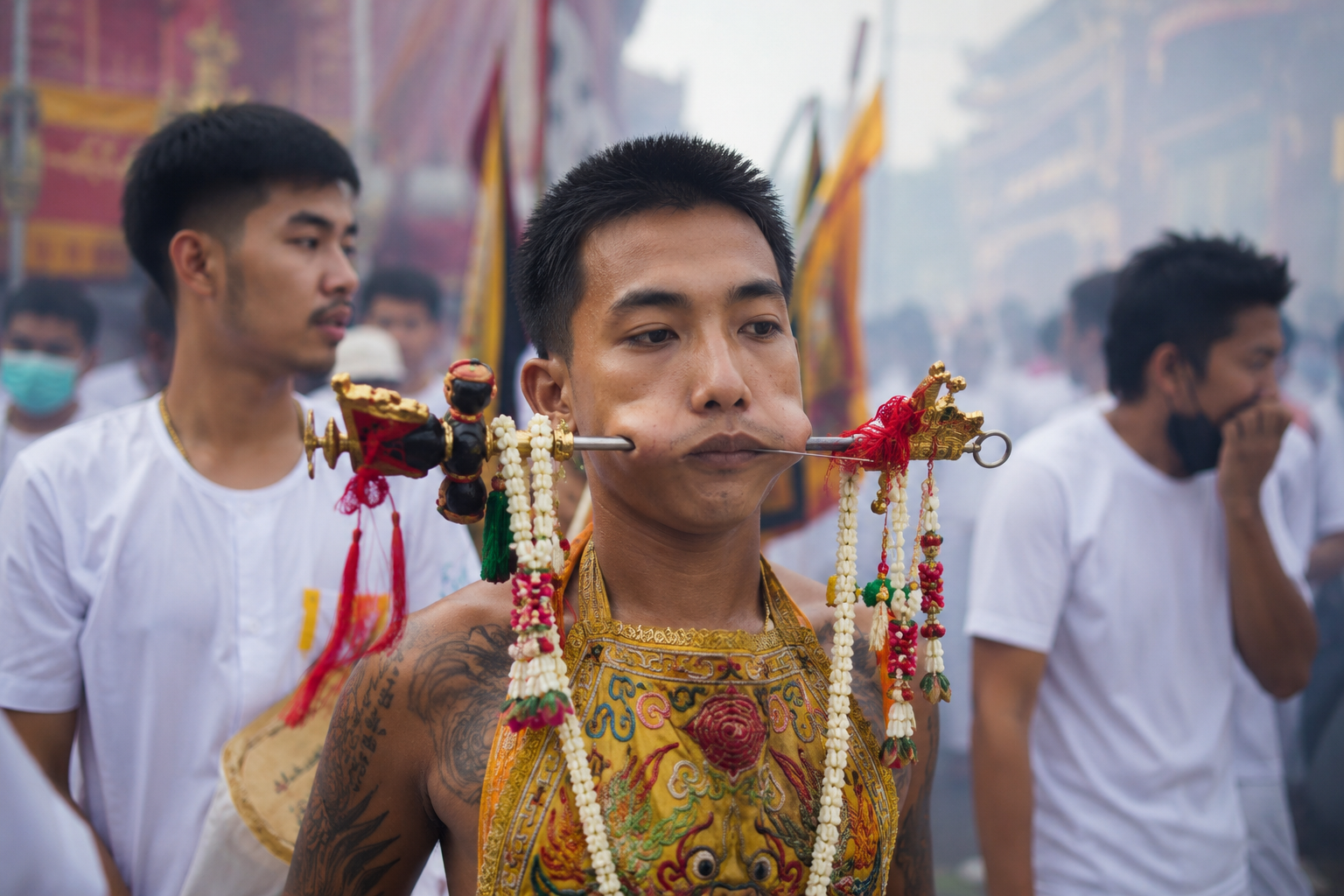
Ma Song are believed to be individuals under divine protection or in a trance state connected to deities. During rituals, they may perform actions that appear extremely painful and dangerous to an ordinary person.
The most famous is piercing their cheeks with various objects. During processions, one can see Ma Song with long metal structures, swords, flags, and other items passing through their cheeks.

For the participants themselves, this is not a show or a way to entertain the public. The rituals have religious significance and are seen as a form of spiritual service and purification.
It is important to understand that stories about Ma Song "feeling no pain at all" or being guaranteed not to get injured are part of popular beliefs about the festival, not medical facts. Tourists should not view what is happening as a safe performance or attempt to imitate what they see.
Why do Ma Song pierce their cheeks?
In traditional understanding, Ma Song act as intermediaries between people and the divine world. It is believed that during a trance state, they are able to absorb negative energy and misfortunes, thereby protecting the community.
That is why the rituals are not so much about demonstrating endurance as they are about religious beliefs concerning protection and purification.
For someone witnessing such a ceremony for the first time, what is happening can appear very brutal. But it is important to remember that participants voluntarily take part in the rituals and perceive them quite differently from an external observer.

Where does the Phuket Vegetarian Festival take place?
The main events take place near Chinese shrines — aams. The shrines of Phuket Town and Kathu play a particularly important role.
One of the most famous is Jui Tui Shrine in Phuket Town. This is one of the main religious centers of the festival, around which large-scale processions take place.
Kathu Shrine also holds great significance, linked to the origin story of the tradition on the island.
Another important location is Bang Neow Shrine, which we discuss separately in the article about Am Bang Neow Temple. During the festival, the shrine becomes one of the venues for religious ceremonies.

In addition to these, events are also held in other Chinese temples throughout the island. This is why the festival cannot be reduced to one location or one procession — each aam has its own program.
How do the processions take place?
One of the main events of the festival is the processions of the gods, which parade through the streets of Phuket.
Early in the morning, large columns of participants depart from the Chinese shrines. People in white clothing carry religious symbols, palanquins, and sacred objects, drums resound, and firecrackers constantly explode around them.
For tourists, this may appear as a colorful street parade, but for the procession participants, it is a religious ritual. Therefore, taking photos is allowed, but it's important not to obstruct people and to maintain a distance.

Processions can completely block roads, causing significant traffic jams in Phuket during the festival. If you plan to travel through Phuket Town on these days, allow significantly more time for your journey.
Why are there so many firecrackers at the festival?
Firecrackers are one of the most distinctive features of the Vegetarian Festival.
They are used during processions and various ceremonies. The loud bangs are considered part of the religious tradition and accompany the movement of sacred palanquins and procession participants.
For tourists, the sheer number of firecrackers can be a surprise. They explode directly in the streets, sometimes quite close to spectators. Therefore, the festival cannot be described as a quiet or peaceful event.
If you have difficulty tolerating loud noises, you should prepare for the noise in advance.
Firewalking and other extreme rituals
In addition to the Ma Song processions, during the festival one can witness fire-walking over hot coals, climbing ladders with blades, and other religious ceremonies.
Such rituals take place in specific shrines and on specific days. They are not a daily part of the program and do not necessarily occur in the same location every year.
This is why you shouldn't rely on old schedules from the internet. Specific dates and times for individual ceremonies can change, and the final program is usually announced closer to the start of the festival.

What tourists need to know
The Vegetarian Festival is not an ordinary city celebration or a theatrical performance. If you come to witness the rituals, it's important to approach them with respect.
Do not try to touch the Ma Song, stand directly in front of procession participants, or block their way for a photo. Do not shout, joke with participants, or mimic their actions.
Be especially cautious near firecrackers. During some processions, they explode literally around participants and spectators, so it's best not to stand in the thick of the procession.
If you wish to see the most extreme rituals, you should understand in advance that the sight of blood, wounds, and medical interventions can be unpleasant even for an adult. We do not recommend such events for small children.

What to wear to the Vegetarian Festival
For a casual stroll through Phuket Town, comfortable clothing is suitable, but if you plan to be directly near a shrine or participate in a religious ceremony, it's best to choose modest and inconspicuous attire.
If you plan to watch street processions, it's especially important to consider footwear. Some rituals involve a large number of firecrackers, ash, smoke, and debris on the road, so open beach shoes may not always be the best choice.
For evening events, protective glasses, a mask, and hearing protection will be useful. Earplugs are especially helpful, as the number of firecrackers during some ceremonies is truly enormous.
A mask can also be useful due to the smoke from incense and firecrackers. If you are sensitive to smoke, it's best to stay away from the immediate vicinity of the ritual.
Can I photograph the Vegetarian Festival?
Photography is allowed during the festival, and it is thanks to photographs that the Vegetarian Festival has become known far beyond Thailand.
However, a good shot should not interfere with what is happening. Do not literally stand in front of a participant, block a procession, or get too close to a Ma Song.
It is especially important to remember that a person with an object passing through their face is not an actor performing for tourists. This is a participant in a religious ritual, and they should be treated accordingly.

Can tourists observe the Vegetarian Festival?
Yes. Many tourists try jay food during the festival and abstain from animal products for several days.
However, it is not mandatory to fully observe religious precepts without understanding their meaning. If you wish to actively participate in the tradition, it is best to familiarize yourself with the rules of a specific shrine beforehand.
For most travelers, it is sufficient to simply respect what is happening, not to disturb believers, and to try traditional food if desired.
Vegetarian food in Phuket during the festival
During the festival, finding vegetarian food on the island becomes significantly easier. Numerous temporary stalls selling jay dishes open in Phuket Town, and existing restaurants may add special items to their menus.
Street food becomes a distinct part of the holiday atmosphere. You can try noodles, rice dishes, fried snacks, vegetable dishes, and various desserts.
However, it is important not to confuse jay with regular Thai vegetarian cuisine. During the festival, restrictions can be significantly stricter and include not only meat and seafood, but also eggs, dairy products, and certain aromatic vegetables.
How the festival affects Phuket
For tourists, the Vegetarian Festival is primarily about unusual rituals, street processions, and food. For the island's residents, the meaning of the holiday is much deeper.
For nine days, Phuket's usual rhythm of life changes. There are significantly more people around the shrines, roads are closed due to processions, temporary markets appear, and many local residents switch to a special diet.
The festival remains a part of the island's living culture, not a reconstruction of an ancient holiday specifically for tourists. This is precisely what makes it so interesting.

Should tourists go to the Vegetarian Festival?
If you are interested in Thai culture, Phuket's Chinese heritage, and unusual religious traditions, the festival is definitely worth seeing at least once.
However, it's important to understand in advance that this is not a colorful carnival in the usual sense of the word. Behind the bright costumes, firecrackers, and street processions lies a serious religious tradition.
If you have difficulty with blood, loud noises, and scenes of physical challenges, it's better to choose calmer festival events and experience it through the culture, food, and architecture of the Chinese shrines.
And if you want to see the most extreme ceremonies, it's worth choosing the right day and location in advance and preparing for large crowds, smoke, and very loud firecrackers.
Phuket Vegetarian Festival in 2026
In 2026, the main nine days of the festival will be held from October 10 to 18.
The detailed schedule of processions, ceremonies in individual shrines, and evening rituals will be posted after the official program is published. This is especially important for those who want to attend a specific procession: the timing of events differs among various Aams, and old schedules from previous years do not always match the current year.
If you are traveling to Phuket in October specifically for the festival, it is best to plan your accommodation considering that the most intense events take place in Phuket Town, Kathu, and near Chinese shrines.
The Vegetarian Festival is much more than shocking photos
For many tourists, their first introduction to the Vegetarian Festival begins with photos of ma-songs, pierced cheeks, and a huge number of firecrackers. But behind these impressive images lies more than two hundred years of tradition of Phuket's Chinese community.
This is a time of prayers, purification, strict rules, white clothing, special food, and обращения to the Nine Emperor Gods. And it is the external, unusual for European tourists, side of the festival that has made it one of Phuket's most famous events.
Therefore, if you find yourself on the island from October 10 to 18, 2026, do not perceive the festival simply as an exotic show. It is an opportunity to witness a living religious tradition that has existed in Phuket for many generations and still holds an important place in the island's life.

Read also:
Excursions in Phuket in summer 2026: where to go in June, July, and August
Best excursions in Phuket in autumn 2026: where to go in September, October, and November