
Secrets of Rang Hill: Phuket's history as told by old photographs
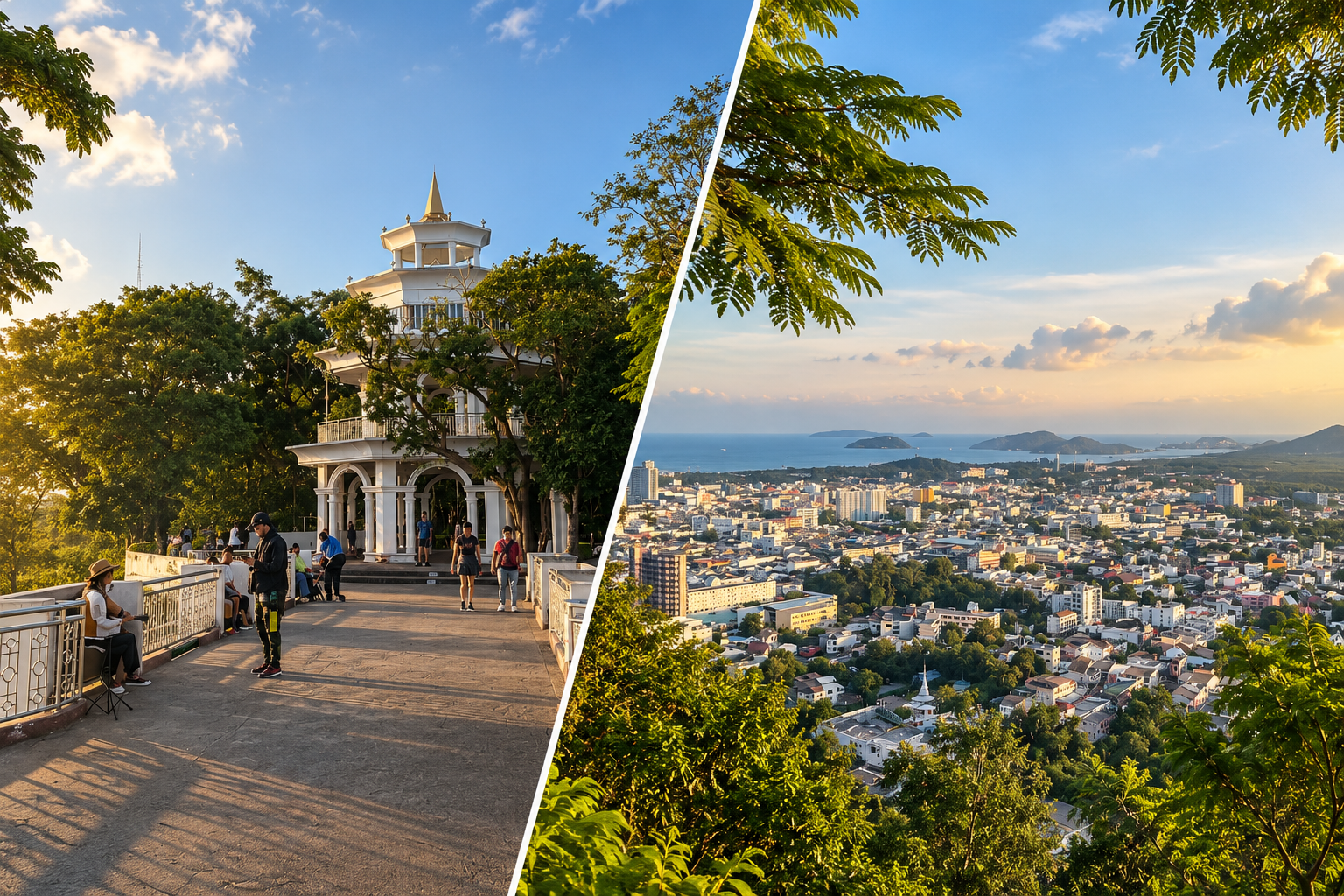
Rang Hill, or Khao Rang, is one of Phuket's most famous viewpoints. The summit offers a panoramic view of Phuket Town, looking out over the surrounding hills, residential areas, and parts of the Old Town. For tourists, it is above all a pleasant spot for a stroll and photos.

Rang Hill is more than just a viewpoint
If you don't just visit Rang Hill for five minutes to take a photo, you can easily spend several hours here. At the summit, there are two well-known restaurants — Tunk-ka Cafe and Khao Rang Breeze Restaurant. Tunk-ka, which has been operating on Rang Hill since 1973, features open-air terraces literally immersed in greenery, and in the evening it is an especially good place to watch the city gradually change from its daytime colors to lights. The restaurant itself specializes in local Southern Thai cuisine and has long become one of the hill's notable attractions.

Khao Rang Breeze is just a few minutes from the main viewpoint. It has a more modern atmosphere, a wooden terrace among the trees, and a panoramic view of the city. In the evenings, there is often live music at the restaurant, so you can easily turn Rang Hill from a standard observation point into a spot for a quiet dinner at sunset.
But the most unexpected part of Rang Hill begins before you even sit down at a table. In the parking and restaurant area, macaques are constantly hanging around. They are so accustomed to people that they can calmly walk between cars, sit on railings, and watch the visitors. It is especially interesting to catch them in the morning when there are still relatively few people on the hill. However, you should not approach the monkeys or feed them: the animals remain wild and can unexpectedly grab food, phones, or other belongings.

And if you arrive very early, you might see even more unusual local inhabitants. Visitors to Rang Hill have reported encounters with wild boars in the area near the viewpoint. Therefore, an early trip here can prove much more interesting than a regular daytime visit.

Near the viewpoint on Rang Hill stands the monument to Phraya Ratsada Nupradit Mahison Phakdi (Kho Sim Bee Na Ranong), one of the most famous governors of Phuket at the beginning of the 20th century. It was under his leadership that the island began to rapidly transform from a primarily trading and mining region into a modern city: he developed the road network and urban infrastructure, supported the construction of schools and hospitals, promoted the development of trade, and was among the first in the country to organize rubber cultivation. During his administration of Phuket, many buildings and roads appeared here that are considered part of the city's historic landscape today.
The monument is not here by chance: Rang Hill was connected to Phraya Ratsada's own plans for the development of Phuket. He ordered a road to be built up the hill and wanted to turn it into a local version of the famous Penang Hill, though he did not live to complete his vision. Today, the monument serves as a reminder of this period in the island's history, and commemorative ceremonies in honor of Phraya Ratsada are held here annually on April 10th.
There are also small local shops here where you can buy soft drinks, fruit shakes, and snacks.
And even the restroom on Rang Hill deserves a separate mention. Khao Rang Breeze, for example, has a rather unusual bathroom with a large glass window overlooking the hill's greenery. Outside, you are hidden by trees, while from the inside, you get an completely unexpected view of the jungle. This is a case where even the most prosaic part of a trip turns into a little adventure.
But Rang Hill is especially nice towards the evening. The sun gradually sets over the city, the roofs of Phuket Town begin to glow gold, and in the distance, the sea, islands, and silhouettes of the hills appear. If you stay until dark, the panorama changes once again: instead of the daytime city, thousands of lights start to glow below. This is exactly why you should come here not only for the daytime view but also for the sunset — to have dinner, listen to live music, and watch how Phuket gradually lights up below. The province's official tourism website also highlights the evening views of Rang Hill, when the city lights become particularly noticeable.

So, Rang Hill is a rather rare case where the viewpoint itself turns out to be only the beginning. You can come for the panorama, stay for the history, get distracted by monkeys, meet wild boars in the morning, drink a fresh fruit shake, and stay in the evening for dinner and the sunset. And it is precisely these details that make the place much more interesting than a standard item on a "best viewpoints of Phuket" list.
But Rang Hill also has another side, of which far from everyone is aware. On the grounds of the viewpoint, you can see historical photographs and information boards in Thai. They tell not so much about the mountain itself, but about the events and people who shaped the development of Phuket in the late 19th and early 20th centuries.

Here you can learn when the first bank appeared on the island, how Chinese education developed, why Phuket's Old Town received its famous Sino-Portuguese look, where the first rubber trees in Thailand came from, and who conceived the idea of turning Rang Hill into a local equivalent of the famous Penang Hill.

We have translated these historical materials and compiled them into one story.
The man who started to change Phuket
The history of Rang Hill is closely linked to the name of Phraya Ratsada Nupradit Mahison Phakdi, better known as Kho Sim Bee Na Ranong. It was his activities that had a major influence on the development of Phuket in the early 20th century.
Kho Sim Bee came from the famous Na Ranong family. His father, Phraya Damrong Sucharit Mahison Phakdi, was the founder of the Na Ranong lineage and the first ruler of Ranong. Kho Sim Bee himself initially held the position of ruler of Kraburi.

In 1890, King Chulalongkorn, Rama V, was traveling through the southern provinces of Thailand and visited Ranong and Kraburi. During the trip, the King took note of Kho Sim Bee's abilities and subsequently appointed him as the ruler of Trang. Along with the new position, his title also changed: he became Phraya Ratsada Nupradit Mahison Phakdi.
In 1901, by royal order, Kho Sim Bee was appointed governor of Phuket. He administered a much larger territory than the modern Phuket province. The administrative district included Phuket, Trang, Phang Nga, Krabi, Takua Pa, Ranong, and Satun.
This was a time when Southern Thailand was changing rapidly. Trade was developing, the Chinese population was increasing, ties were being established with neighboring Penang, new technologies were appearing, and urban architecture and transport infrastructure were changing.
Phraya Ratsada was actively involved in the development of Phuket and sought to turn the city into a modern trade and administrative center.
How Phuket began to look new
Today, the Sino-Portuguese buildings of the Old Town are considered one of Phuket's main attractions. Bright facades, narrow streets, decorative elements, and long shophouses have long become a recognizable symbol of the island.
However, this architectural look did not appear by accident.
During Phraya Ratsada's administration, Phuket maintained close ties with Penang. Along with trade between the two territories came people, ideas, technologies, and cultural traditions. New knowledge about construction and urban space organization flowed from Penang to Phuket.

Phraya Ratsada was involved in the city's development and devised a new master plan. It was during this period that Sino-Portuguese architecture began to spread actively in Phuket.
Therefore, when walking through the Old Town today, it is worth remembering that the historic buildings familiar to tourists are part of a much larger process. Phuket was gradually becoming an international trading city, closely connected to other ports in the region.
Thailand's first reinforced concrete building
One of the symbols of this era became the Phuket provincial administrative building.
According to information on the historical board, it was built between 1907 and 1913, when Phraya Ratsada Nupradit Mahison Phakdi was serving as the governor of Phuket. Later, the building was registered by the Department of Fine Arts and declared a historic monument. The corresponding announcement was published in the Royal Gazette on May 10, 1977.

The story of its construction is particularly interesting.
Phraya Ratsada entered into an agreement with the Tungkha Combet company, which received permission to mine minerals on the site of a former government facility in exchange for the construction of a new administrative building. Thanks to this scheme, it was not necessary to use the state budget for construction.
The company hired Italian experts, who handled the design and supervised the construction work.
The result was a building with European architectural style, which the historical materials at Rang Hill call the first reinforced concrete building in Thailand.
Today, it is not just an old administrative structure. It shows how rapidly the technologies and architecture of Phuket were changing in the early 20th century.
Where rubber came from in Southern Thailand
Another story that is easy to miss among Phuket's more famous attractions is connected to rubber trees.
In 1901, Phraya Ratsada Nupradit, together with his nephew Phra Sakhon Satan Phithak, who was the ruler of Trang at the time, brought the first rubber trees to be cultivated in Thailand. The first plantings appeared in the Kantang district of Trang province.

The plants began to be propagated, and local residents were encouraged to engage in rubber tree farming. Over time, rubber turned into one of the most important agricultural crops in the south of the country.
Today, rubber plantations can be seen in many provinces of Southern Thailand, so it is difficult to imagine that these trees were once a completely new plant here.
And this also demonstrates the scale of the changes that occurred in the region at the beginning of the last century: new crops, technologies, and trade ties were gradually changing the economy of Southern Thailand.
The Chinese population and the creation of the Phuket Thai Hua school
It is impossible to imagine the development of Phuket without the Chinese community. In the late 19th and early 20th centuries, more and more Chinese arrived on the island. Along with them, trade, crafts, education, and religious life developed.
Historical materials at Rang Hill state that between 2444 and 2456 in the Buddhist calendar, during Phraya Ratsada's administration, the Chinese population of Phuket continued to grow.
The children and descendants of Chinese immigrants initially studied the Chinese language at Chinese shrines and from private tutors. Later, the Chinese community joined together to create a full-fledged Chinese language school.
It was named "Siosok" and was initially associated with the school at the Chinese shrine on Krabi Road.
Over time, the school's name, teaching system, and curricula changed. In 2460 of the Buddhist calendar, an additional building appeared, and in 2477, a permanent building was constructed on Krabi Road.

At different times, the school was known as Hua Bun and Chung Hua, and subsequently received the name by which it is known today — the Phuket Thai Hua School.
This story clearly shows how important a role the Chinese community played in shaping modern Phuket. Its influence remained not only in the architecture of the Old Town but also in the language, education, trade, and culture of the island.
The first bank in Phuket
At the beginning of the 20th century, Phuket was already an important trading center, but its own banking infrastructure did not yet exist.
A historical board at Rang Hill states that around 2450 in the Buddhist calendar, during the reign of Rama V, Phraya Ratsada approached the Chartered Bank with a proposal to open a branch in Phuket.
The branch was transferred here from Penang. A spot was allocated for it at the corner of the intersection near the Yai market. Opposite the bank, a police station was built at the same time.

Thus, the Chartered Bank became the first foreign bank in Phuket.
Its appearance was primarily due to growing international trade. The bank handled money transfers and operations related to foreign trade, as well as the transfer of state revenues to the royal treasury in Bangkok.
The very fact of the bank's appearance well reflects the changes taking place on the island. Phuket was becoming increasingly integrated into the international trading system, and its ties with Penang and other ports were becoming more and more important.
Roads that led to Phuket's future
The development of trade and the city required good communication between districts.
Phraya Ratsada planned the construction of many roads in Phuket Town in advance. Among them was the road leading to the summit of Rang.
And here the story returns directly to the place where the viewpoint is located today.

Phraya Ratsada wanted to develop Rang Hill and turn it into a local equivalent of Penang Hill. Perhaps his decision was influenced by Phuket's close familiarity with Penang, where the mountain of the same name had already become a famous place for recreation and attraction.
However, he did not manage to fully realize this plan.
Phraya Ratsada Nupradit Mahison Phakdi died before the construction was completed.
Vachira Phuket Hospital — the beginning of modern medicine on the island
Another important project of the Phraya Ratsada era was the development of modern medicine in Phuket. With his participation, a hospital appeared in the city where treatment was gradually moving away from traditional methods toward the modern medical standards of that time. The first doctor to work at the hospital was a British doctor, and the institution itself became one of the first centers for modern medical care on the island. Later, an X-ray machine appeared here — according to historical materials, it was the first X-ray machine in Thailand, which was a very significant event for a small provincial town at the beginning of the 20th century.

The old hospital eventually became too crowded, and its grounds regularly suffered from flooding. During King Rama VI's trip to the south in 1917, the issue of a new hospital building was considered at the royal level. A site at the foot of Rang Hill, on Yaowarat Road, was chosen: there was more space, good air, access to water, and a convenient location near the road. The King allocated 30,000 baht from his personal funds for the construction of the new complex. Subsequently, the hospital was granted the name "Vachira," associated with the name of Rama VI, and the new institution officially opened on January 1, 1920.
And here there is an interesting connection to Rang Hill itself: the current Vachira Phuket Hospital is still located at the foot of the hill. In other words, when we look at Rang Hill, we are not just talking about a place with a beautiful panorama—one of the most important monuments of Phuket's medical history is located right nearby.
Why Rang Hill is more than just a viewpoint
Today, Rang Hill is primarily perceived as a place with a beautiful view of Phuket Town. Tourists come here for a few dozen minutes, take photos, and head off to the Old Town, temples, beaches, or other attractions.
But if you stop here a little longer and pay attention to the historical photographs and Thai texts, Rang Hill begins to look completely different.
The history of Phuket in the early 20th century gradually unfolds before your eyes.
Here is the governor who plans the development of the city and paves new roads. Here are the first reinforced concrete structures and the Italian specialists who participated in their construction. Here is the Chinese community establishing its own school. Here is the first foreign bank connecting Phuket to international trade. Here are the rubber trees that would later change the agriculture of all of southern Thailand.
And all this happened in roughly the same historical era.
In this sense, Rang Hill becomes a kind of vantage point from which you can look not only at modern Phuket, but also at its past.

The Phuket that remained behind the panorama
The unique thing about such historical materials is that they allow you to see a familiar tourist island from a completely different perspective.
Modern Phuket is associated with beaches, hotels, restaurants, boat tours, and nightlife. But its current appearance was formed long before the advent of mass tourism.
In the early 20th century, the island was going through a period of major transformation. International trade was developing, the Chinese population was growing, new technologies and construction methods were emerging, urban planning was changing, and schools and banking infrastructure were being created.
And Rang Hill turned out to be part of this process.
Perhaps that is why, today, it is worth looking from its summit at more than just the city below. If you know the history, old roads, commercial quarters, early administrative buildings, and a city that was just starting to transform into the Phuket we know now begin to emerge behind the familiar panorama.
Phraya Ratsada’s idea to create his own "Phuket Hill" here was never fully realized in his lifetime. But more than a hundred years later, Rang Hill has finally become one of the places from which residents and visitors to the island look out at Phuket.
Only now, along with the panorama, you can see one more thing here: the history of the city, which is literally hidden on display boards among the trees and tourist paths.
And if you find yourself on Rang Hill next time, don't rush to leave immediately after taking a photo of the city view. Stop by the old pictures and Thai texts.
Perhaps that is where the most interesting part of this viewpoint is located.

Read also:
Best excursions in Phuket in autumn 2026: where to go in September, October, and November
Excursions in Phuket in winter 2026-2027: where to go in December, January, and February