






Am Bang Niew Temple in Phuket – history, architecture, and how to visit
Am Bang Neow (Am Bang Neow) is one of Phuket's oldest Chinese temples, located in Phuket Town. The shrine is also known as the Bang Neow Shrine, Bang Niew Shrine, Tao Bo Keng Shrine, and Theprasi Foundation Shrine.
Unlike the island's major tourist attractions, Am Bang Neow remains primarily an active place of worship. Locals come here to pray, make offerings, and participate in traditional ceremonies.

The temple is particularly interesting to travelers who want to explore Phuket's Chinese cultural heritage and see a side of the island that cannot be fully appreciated by spending an entire holiday only on the beaches.
Where is Am Bang Neow located?
Am Bang Neow is located in Phuket Town on Phuket Road, near the Bang Neow intersection. The temple is situated not far from the Saphan Hin area and just a few minutes' drive from the historic center of Phuket Town.

The shrine is easy to find: the main landmark is a large decorative dragon-shaped arch at the entrance. Thanks to its location in the urban part of the island, a visit to Am Bang Neow can be conveniently combined with a walk through Old Town and other Phuket Town attractions.
The history of Am Bang Neow Temple
The history of Am Bang Neow dates back to 1904. The shrine was originally located in the area of today's Soi Romani in Phuket Old Town. After several fires, the temple was moved from place to place until it reached its current site in the Bang Neow area.

The temple's history is closely linked to Phuket's Chinese community. In the late 19th and early 20th centuries, Chinese immigrants played a major role in the island's development, especially in trade and the tin industry. Along with them, Chinese religious and cultural traditions took root on Phuket.
According to Prince of Songkla University, the shrine's original history is linked to a Chinese opera troupe that came to Phuket for performances and brought with it the revered deity Tian Hu Yuan Shuai, known to locals as Lao Ya. It was around this cult that the community associated with the future Am Bang Neow Temple subsequently formed.
In 1958, Theprasi Shrine Foundation was established, which still manages the shrine today. Throughout its history, the temple has been repaired numerous times while maintaining its significance as one of Phuket's important Chinese religious centers.

Why Am Bang Neow is called a Chinese temple
Am Bang Neow differs from most Thai Buddhist temples familiar to tourists. It is a Chinese shrine shaped by the traditions of Phuket's Chinese community.
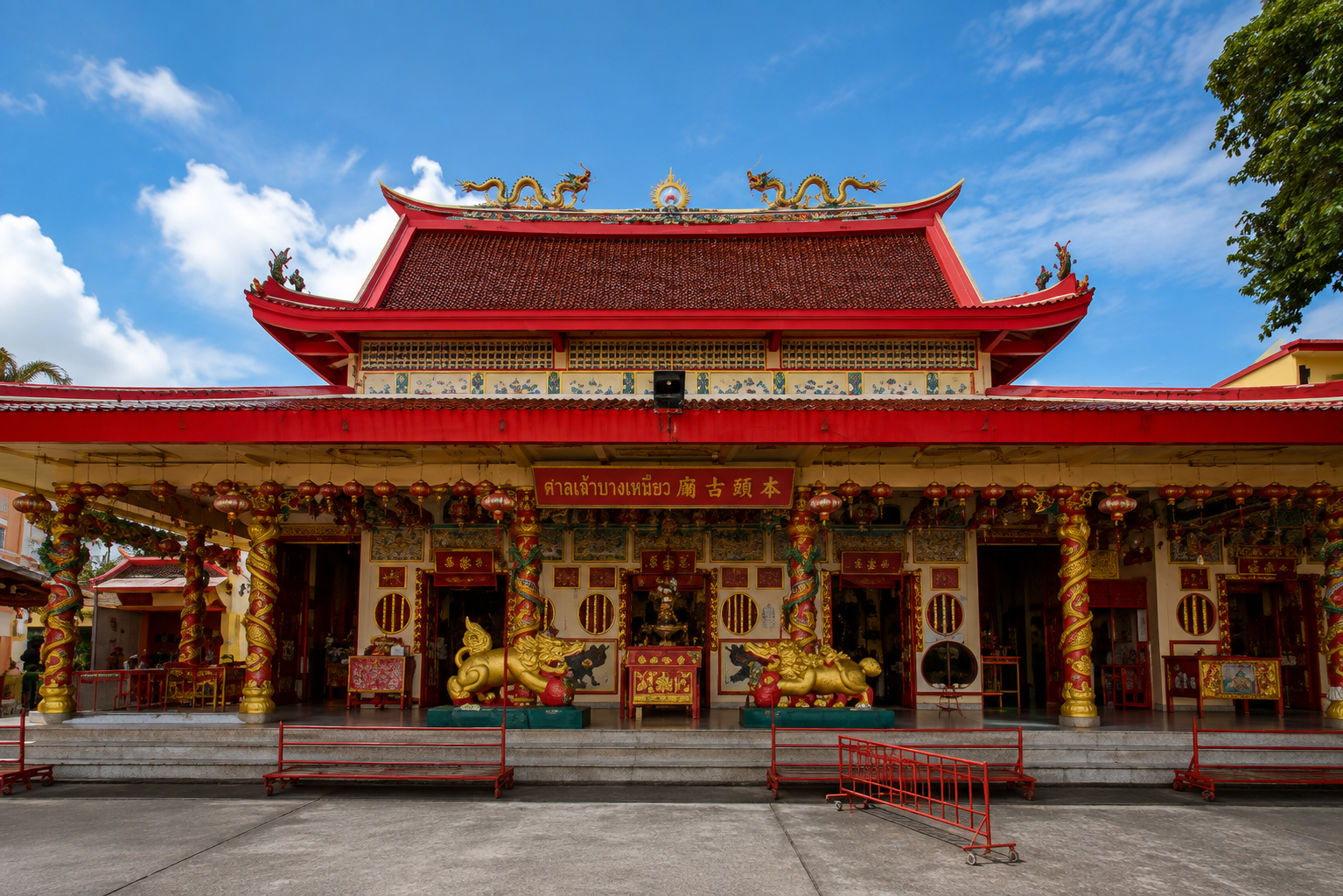
Even at the entrance, the red-and-gold color scheme, decorative dragons, traditional motifs, and numerous elements of Chinese temple architecture catch the eye. The central part of the facade is adorned with a richly decorated arch, while figures of mythical creatures and temple guardians stand on either side of the entrance.
Inside the shrine are images of Chinese deities, altars, and religious objects. The interior features a large number of decorative details, making the temple interesting not only from a religious perspective but also an architectural one.

Am Bang Neow and Phuket's Chinese culture
Chinese heritage is an important part of Phuket's history, especially Phuket Town. It is here that the blending of Chinese and Thai traditions, which has developed over several generations, is most evident.
Am Bang Neow is one example of how Chinese religious culture has been preserved on the island and become part of modern life in Phuket. Therefore, visiting the shrine allows you to see not just a beautiful historic building, but an active place that continues to play a role in the life of the local community.

Am Bang Neow during the Vegetarian Festival
Am Bang Neow is one of the main Chinese shrines participating in the annual Vegetarian Festival in Phuket. This is why the temple grounds and surrounding streets become significantly livelier during the festival.
There is no need to discuss the festival itself in detail in this article: it is a separate major topic covering the history of the celebration, its religious meaning, ceremonies, and procession routes.
If you are planning a trip to Phuket during the festival, Am Bang Neow is worth considering as one of the important sites associated with the island's Chinese religious traditions.

What to see in the temple
The architecture and large number of decorative details make the greatest impression at Am Bang Neow. The facade is adorned with gold elements, dragons, and traditional Chinese motifs, while temple figures guarding the sacred grounds stand before the entrance.
Inside, you can see altars dedicated to Chinese deities, red lanterns, decorative paintings, and numerous religious objects. When visiting, pay attention not only to the central altar but also to the small decorative details—they best convey the character of the Chinese shrine.
For photography, the temple is particularly interesting from the outside: the decorative arch and dragons are highly recognizable and are characteristic features of this part of Phuket Town.

When is the best time to visit Am Bang Neow?
If your goal is to quietly explore the temple and take photographs, it is best to come outside of major religious events. On regular days, there are far fewer people, and you can explore the shrine's architecture at your leisure.
During the Vegetarian Festival, the atmosphere is completely different: the temple becomes part of large-scale religious events, so it can be crowded, noisy, and very lively.
Thus, the choice of time depends on the purpose of your visit. A regular day is suitable for exploring the architecture, while those interested in the vibrant religious culture of Phuket's Chinese community may enjoy seeing Am Bang Neow during one of the traditional holidays.
Rules for visiting a Chinese temple
Am Bang Neow is not a museum or simply a tourist attraction, but an active shrine. Therefore, you must treat it with respect during your visit.
Do not speak loudly, disturb people while they are praying, or touch religious objects and offerings without permission. You may photograph the temple, but during religious ceremonies, it is best not to get too close to the participants or disturb them.
Clothing should be modest. Even though this is a Chinese shrine rather than a traditional Thai Buddhist shrine, beachwear is not suitable for visiting a place of worship.
What to see near Am Bang Neow
The temple's convenient location allows you to combine a visit with a walk through Phuket Town. From here, it is easy to head to the historic part of town, where old trading houses, colorful facades, and Sino-Portuguese buildings are preserved.
Other Chinese shrines, local cafes, and city attractions are also nearby. Therefore, it is best to view Am Bang Neow not as a separate trip across the island, but as one of the stops while exploring the cultural and historic part of Phuket.
Is Am Bang Neow worth visiting?
Am Bang Neow is worth visiting for those interested in Phuket's history, Chinese culture, and unusual religious attractions. It is not a place for a lengthy multi-hour excursion, but the temple is well suited for a short stop during a walk through Phuket Town.
The main value of Am Bang Neow lies not only in its striking architecture. It is one of the island's oldest active Chinese temples, which for over a century has maintained its connection with the local Chinese-Thai community.
If you want to see a side of Phuket that is neither beach nor resort, but rather the island's historic side, Am Bang Neow will be a great addition to your Phuket Town itinerary.

Read also:
Winter excursions in Phuket 2026-2027: where to go in December, January, and February
Useful information for visitors to Phuket